
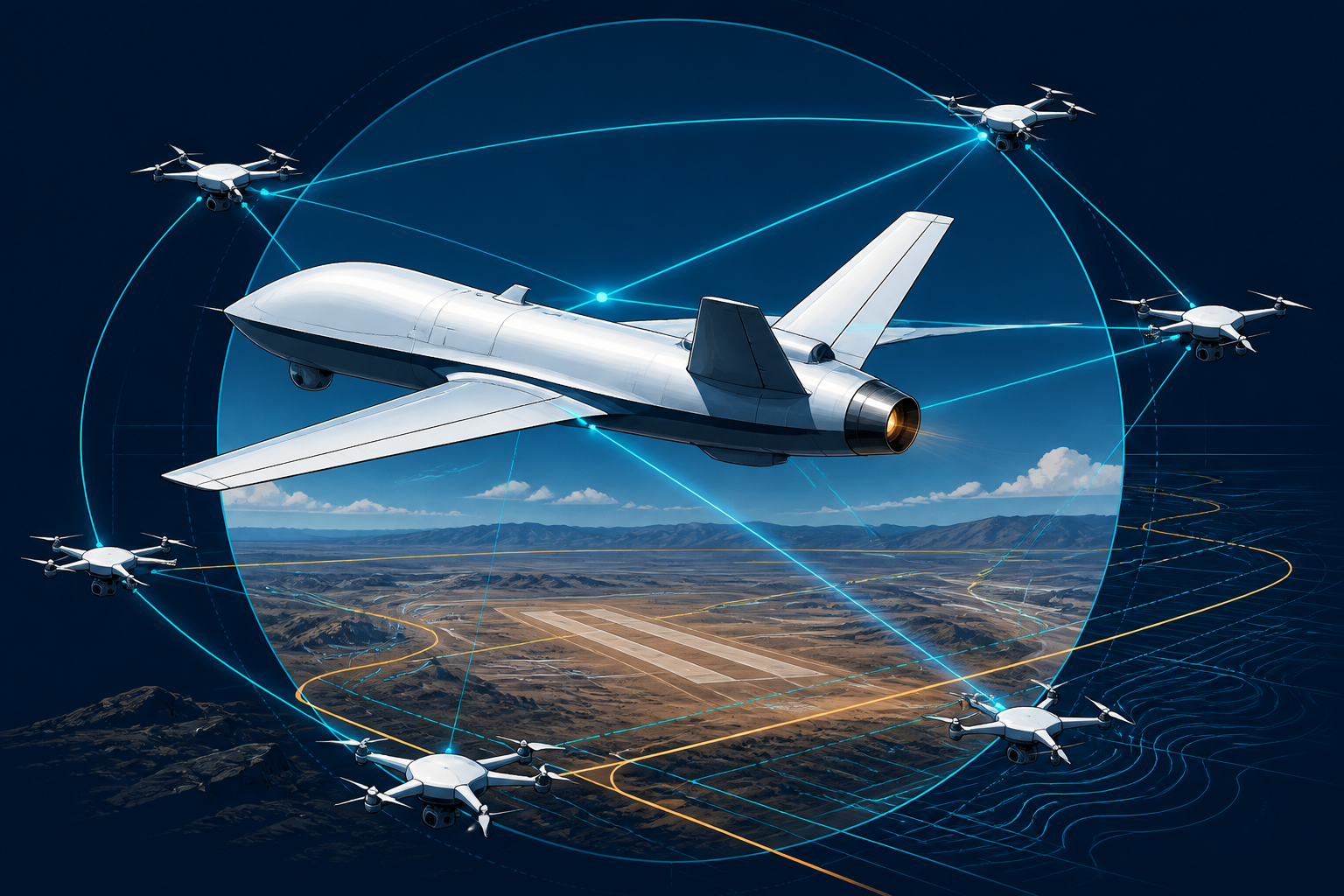
Advanced autonomy and swarm coordination
Non-weaponized multi-drone swarms operating in degraded radio environments increasingly utilize peer-to-peer relative localization and collaborative visual odometry to maintain separation without total reliance on global navigation satellite signals:
- Asynchronous heartbeat monitoring: Swarm flight controllers track inter-node communication health using rapid handshake pings. If an individual node misses successive telemetry heartbeats, adjacent units dynamically recalculate their local collision envelopes rather than assuming the lost node is stationary.
- Consensus-based trajectory adjustments: When navigating dynamic obstacles, decentralized autonomy suites compute shared trajectory adjustments across the local cluster. Each aircraft broadcasts its planned avoidance path to nearest neighbors, validating clearance before initiating maneuvers.
- Deterministic sensor-loss fail-safes: If onboard optical or ranging sensors fail on a single node, the system must trigger a deterministic holding maneuver or a sequenced, vertical escape profile. This ensures the degraded vehicle exits the formation without crossing the flight paths of active units.
Jet-powered drones and propulsion
Small turbine and jet propulsion systems offer high dash speeds, but they introduce unique center-of-gravity and aerodynamic challenges not present in battery-powered systems:
- Dynamic mass and balance shifts: Unlike battery platforms that maintain constant weight distribution, jet-powered uncrewed aircraft burn liquid fuel rapidly. Fuel consumption alters the aircraft center of gravity throughout the flight profile, requiring adaptive trim logic and multi-tank balance management.
- Compressor stall and inlet dynamics: High-G maneuvers or rapid angle-of-attack changes can disrupt intake airflow, creating compressor stall risks. Flight control software must enforce conservative flight envelope protections to maintain clean airflow into the micro-turbine.
- Ground debris and launch risks: High-velocity turbine intakes are vulnerable to foreign object debris during ground runs and catapult launches. Ground crews must enforce sterile, swept launch corridors and strict intake inspections before engine spool-up.
- Fuel line management: Jet-A and kerosene systems require pressurized lines and reliable shutoff valves. Ground protocols must include systematic fuel line venting and post-flight drainage to prevent fuel stagnation and fire hazards.
Civilian applications and readiness
Commercial programs must separate operational realities from experimental prototypes:
- Demonstrated operations: Multi-aircraft multi-rotor deployments are actively utilized in civilian sectors for wide-area search grids, cooperative agricultural coverage, and large-scale linear infrastructure inspection.
- Prototypes and research concepts: High-speed jet platforms remain experimental in civilian operations. Primary civilian research focuses on rapid atmospheric sampling and high-altitude meteorological data collection.
- Regulatory status: Operating multiple autonomous aircraft simultaneously or flying jet-powered unmanned platforms is not automatically permitted under standard Part 107 rules. These operations require dedicated FAA waivers, exemptions, or specialized operational authorizations. Always verify current waiver pathways with the FAA.
Training and safety priorities
Operating advanced autonomous clusters and micro-turbine propulsion requires dedicated crew training protocols:
- Simulator-based swarm deconfliction: Supervisors should train on simulation platforms that introduce sudden node dropouts, forced cluster aborts, and asynchronous link failures across multi-vehicle operations.
- Dynamic fuel failure scenarios: Pilots operating high-speed systems must rehearse wave-offs and emergency glide profiles in simulators, accounting for changing airframe weight as fuel depletes.
- Propulsion ground safety: Flight teams must practice emergency turbine shutoff procedures, static grounding during fueling, and flight-line fire suppression protocols. Note that Elite Drone School does not provide jet-flight certification.