
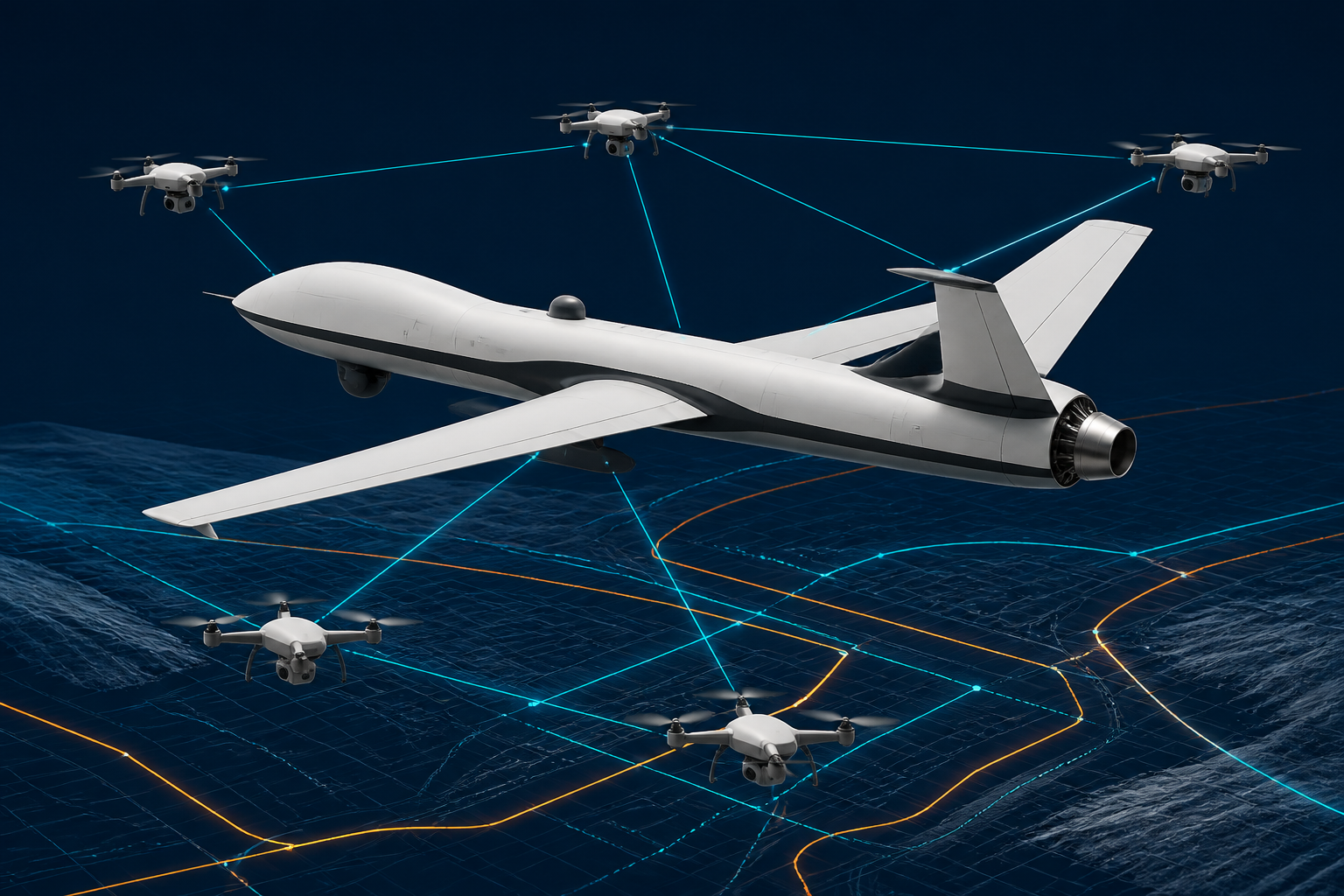
Advanced autonomy and swarm coordination
Non-weaponized multi-drone swarms operating in industrial environments increasingly rely on dynamic role reassignment to maintain formation integrity. If an anchor node or primary communications relay drops out, the remaining aircraft must autonomously redistribute tasks and update relative spatial coordinates without manual intervention:
- Dynamic role handoff: Control software distributes state estimation across the local mesh network. When telemetry from a leading node degrades, onboard algorithms promote a secondary aircraft to coordinate cluster navigation.
- Link degradation containment: When radio-frequency interference increases, autonomous systems must expand inter-vehicle safety bubbles proportionally to communication latency. If packet loss exceeds safe operational thresholds, the swarm must execute deterministic holding patterns or staggered vertical separation to prevent mid-air conflicts.
- Supervisory intent control: Remote operators manage the swarm through high-level intent vectors, such as bounded search corridors or perimeter shapes, while low-level collision avoidance and trajectory generation remain fully onboard.
Jet-powered drones and propulsion
Micro-turbojet propulsion systems provide high ingress speeds and rapid high-altitude climb capability, but they present demanding operational and thermal constraints:
- Thermal soak and shutdown cycles: Micro-turbines generate intense internal heat that must dissipate safely post-flight. Ground crews must execute active cooling cycles to prevent bearing seizure and structural heat damage after engine shutdown.
- Fuel system dynamics: Jet-A and kerosene fuel systems require positive-pressure delivery to prevent vapor lock during rapid climbs or sudden pitch adjustments. Static grounding protocols are mandatory during all fueling operations.
- Recovery kinetic loads: High wing loading and elevated stall speeds prevent short-field visual landings. Recovery profiles depend on high-speed parachute deployment systems, arresting cables, or skid landings on prepared ground, all of which place heavy fatigue stress on the airframe.
Civilian applications and readiness
Commercial programs must clearly separate demonstrated operational capabilities from experimental concepts:
- Demonstrated operations: Multi-drone multi-rotor networks are actively utilized for wide-area photogrammetric mapping, agricultural field analysis, and cooperative search and rescue operations. These multi-agent architectures provide proven coverage redundancy.
- Prototypes and research: High-speed jet platforms remain experimental in the civilian market, primarily restricted to specialized high-altitude atmospheric research and rapid meteorological data gathering.
- Regulatory status: Operating multi-drone swarms or jet-powered aircraft is not automatically permitted under standard Part 107 rules. Scaled multi-vehicle supervisory flights and turbine operations require specific FAA waivers, exemptions, or experimental airworthiness certificates. Operators must verify current petition pathways directly with the FAA.
Training and safety priorities
Operating advanced autonomous swarms and high-energy propulsion platforms requires distinct simulation and ground safety protocols:
- Consensus-failure simulations: Flight teams must practice managing multi-agent simulator scenarios where inter-node communication drops, training supervisors to verify deterministic separation rather than attempting chaotic manual stick overrides.
- Turbine ground safety drills: Ground crews must maintain strict training on hot-start containment, high-temperature fire suppression, and rapid fuel-cutoff procedures on the flight line.
- Override hierarchies: Enterprise standard operating procedures must define clear thresholds for when a human supervisor must command a system-wide abort versus allowing onboard autonomy to resolve local airspace conflicts. Elite Drone School provides advanced supervisory risk training and SMS workflow courses, but does not provide jet-flight certification.