
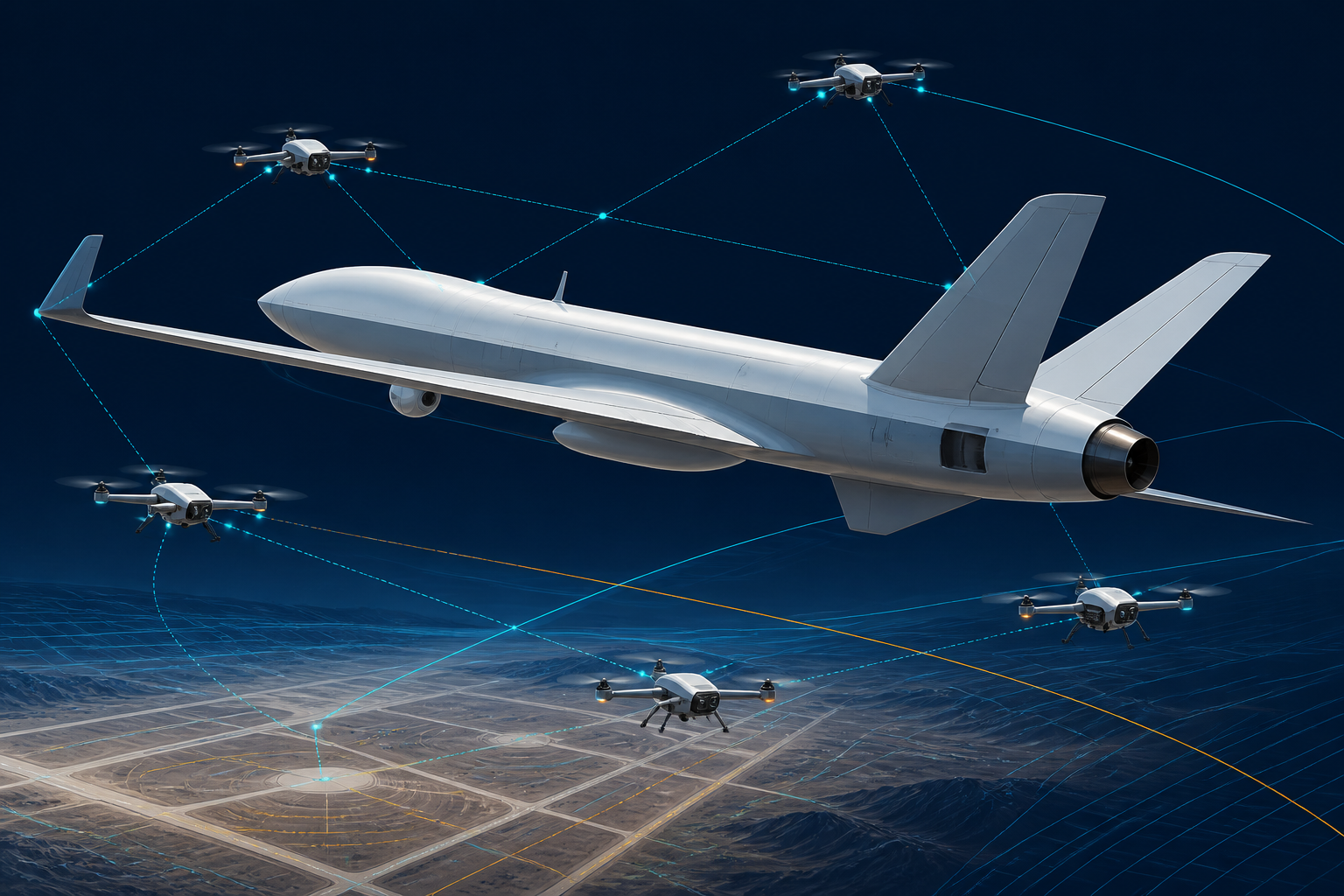
Advanced autonomy and swarm coordination
Coordinating non-weaponized multi-drone swarms in congested operational volumes requires dynamic spatial partitioning rather than static path planning. When operating multiple autonomous aircraft simultaneously, flight management software must divide airspace dynamically to prevent mid-air conflicts:
- Corridor allocation and latency tolerance: Swarm nodes must communicate spatial occupancy across local ad-hoc networks. Control algorithms must account for radio-frequency latency, ensuring separation buffers automatically expand if inter-node communication slows.
- Deterministic response to network partitioning: If a communication blackout isolates a subgroup of drones, the isolated units must not attempt chaotic independent return paths. Systems should execute deterministic local station-keeping or enter pre-designated safe descent corridors.
- Human supervisory control: Enterprise operations rely on supervisory intervention rather than manual stick inputs. Operators maintain authority over dynamic geofences, mission abort triggers, and contingency boundaries, while onboard autonomy handles real-time intra-swarm collision avoidance.
Jet-powered drones and propulsion
Small micro-turbine and jet-powered unmanned aircraft offer extreme airspeed and high-altitude reach, but they introduce unique engineering and operating constraints:
- Spool-up latency: Unlike electric brushless motors that deliver near-instantaneous torque, micro-turbines exhibit measurable spool-up lag. Autonomy algorithms and remote pilots must anticipate power demands early during wave-offs or dynamic maneuvers.
- Thermal management and ground risk: Exhaust temperatures require strict standoff perimeters on the flight line during start-up and taxi. Ground crews must establish cleared, heat-resistant run-up areas to prevent fire hazards.
- Fuel systems and airframe wear: Handling Jet-A or kerosene demands dedicated filtration, defueling systems, and grounding hardware to dissipate static electricity. Turbine operations accelerate structural fatigue, requiring rigid inspection cycles for compressor wheels and bearings.
- Launch and recovery footprint: High landing speeds preclude conventional vertical or short-field recoveries. Operations depend on catapult systems, runway infrastructure, or parachute capture nets, creating extensive site setup constraints.
Civilian applications and readiness
Commercial enterprises are exploring layered operational concepts that combine high-speed propulsion with multi-agent autonomy:
- Layered disaster and search operations: Concept workflows evaluate high-speed jet platforms for rapid initial wide-area reconnaissance, identifying points of interest before dispatching multi-rotor swarms for low-altitude, detailed search grids.
- Demonstrated reality versus experimental testing: Multi-rotor swarms for precision agriculture, aerial mapping, and infrastructure imaging represent demonstrated capabilities operating under tightly controlled waivers. Conversely, civil jet-powered platforms remain experimental testbed concepts, limited to specialized flight test corridors.
- Regulatory authorization: Neither autonomous swarm deployments nor jet-powered unmanned aircraft fall under standard Part 107 rules. Operating these systems requires specialized regulatory relief, experimental airworthiness certificates, or complex operational waivers. Verify all approval requirements directly with the FAA.
Training and safety priorities
Scaling advanced autonomy and high-energy propulsion requires rigorous training protocols focused on system failure modes:
- High-speed containment drills: Flight crews must train on rapid geofence containment failure scenarios, verifying that automated flight termination systems engage before high-speed platforms breach operational safety buffers.
- Network failure simulation: Simulator exercises should expose supervisors to partial mesh collapse, testing their ability to manage staggered recoveries without inducing inter-vehicle conflicts.
- Propulsion emergency procedures: Ground teams require hands-on training for wet starts, turbine over-temperature alerts, and emergency fuel shutoff procedures.
- Training scope: Enterprise programs must focus on supervisory systems management and autonomous safety workflows. Elite Drone School provides advanced operational safety and autonomy workflow training, but does not provide jet-flight certification.