
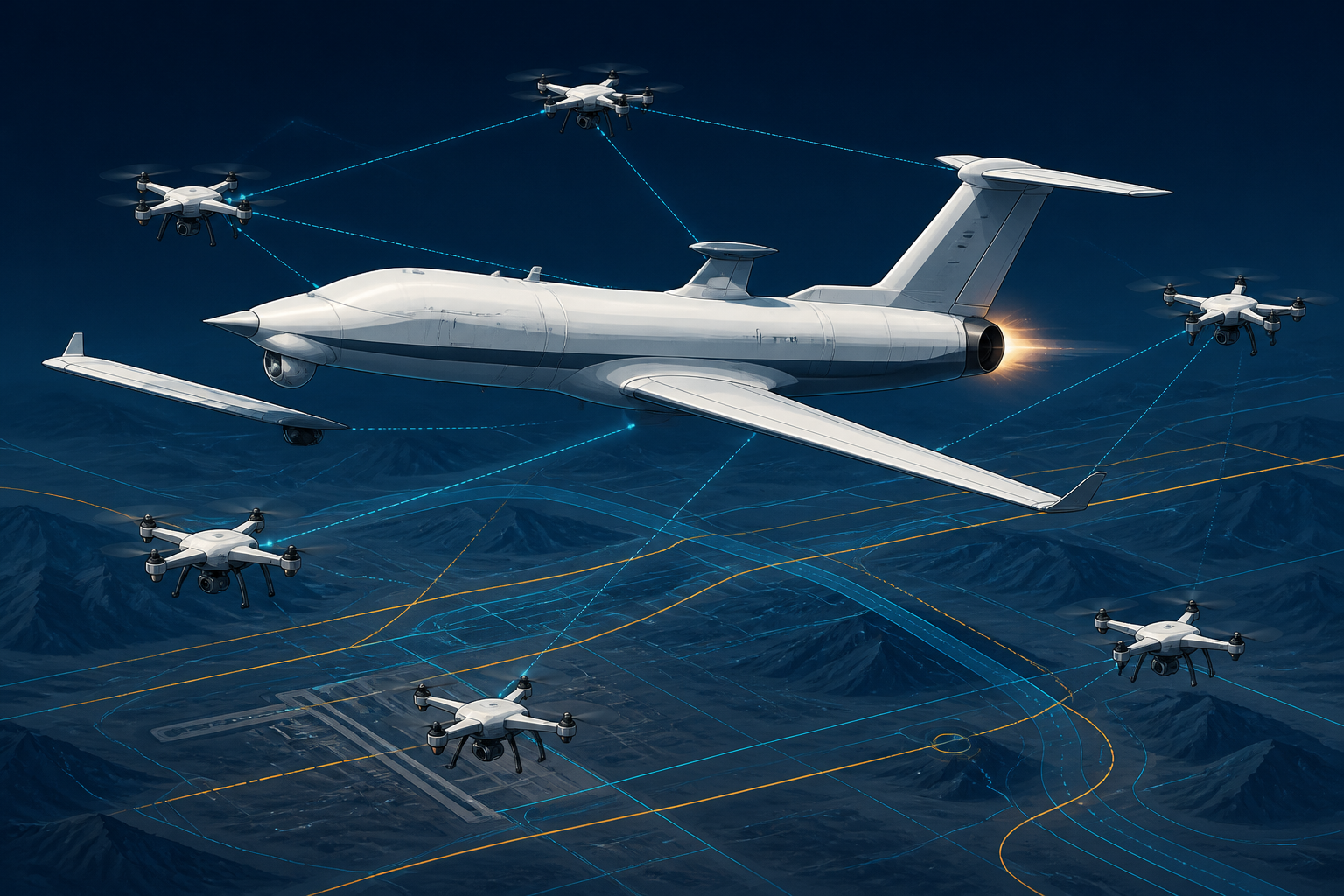
Advanced autonomy and swarm coordination
Non-weaponized multi-agent swarms rely on decentralized mesh networking and collaborative state estimation to maintain geometry without continuous operator intervention. When individual nodes lose command-and-control (C2) links, deterministic safety logic must prevent cascading failures:
- Distributed state management: Swarm architectures distribute positional data peer-to-peer. If primary ground station telemetry drops, nodes transition to local radio-frequency ranging and optical flow to preserve minimum separation.
- Deterministic link-loss containment: Rather than executing simultaneous return-to-home paths that risk inter-vehicle collision, robust autonomy suites assign pre-allocated holding orbits and staggered recovery altitudes based on node priority.
- Supervisory human oversight: Enterprise deployments maintain one-to-many supervisory control interfaces. The human operator defines operational volumes, velocity boundaries, and mission objectives, while onboard flight controllers manage dynamic path generation and intra-swarm deconfliction.
Jet-powered drones and propulsion
Micro-turbine and jet-powered unmanned aircraft offer rapid ingress speeds and high-altitude capabilities, but they introduce strict operational tradeoffs:
- Endurance and fuel consumption: Jet propulsion provides high airspeed at the expense of low-altitude loiter time. Specific fuel consumption rises sharply at low altitudes, demanding precise mission timing.
- Logistics and handling: Jet-A or kerosene handling introduces volatile liquid storage requirements, dedicated defueling protocols, and strict static grounding procedures on the flight line.
- Thermal and acoustic profiles: High exhaust gas temperatures require clear standoff zones behind the airframe during ground runs. Intense acoustic signatures limit low-altitude deployment near populated or noise-sensitive areas.
- Launch, recovery, and maintenance: High stall speeds eliminate standard hand-launch or short-field multi-rotor landing profiles. Operations require catapult rails, pneumatic launchers, arresting gear, or paved surfaces, alongside rigorous turbine cycle inspections and bearing overhaul schedules.
Civilian applications and readiness
Commercial programs must separate operational realities from experimental prototypes:
- Demonstrated operations: Multi-vehicle multi-rotor grids are currently utilized in commercial mapping, wide-area search and rescue, and agricultural spraying. These setups demonstrate proven value in coverage efficiency and real-time sensor coverage.
- Prototypes and research concepts: High-speed jet platforms remain largely experimental in civilian markets. Early testbeds explore high-altitude atmospheric data sampling, rapid-response disaster recon, and long-range corridor monitoring.
- Regulatory status: Neither multi-vehicle swarms nor jet-powered aircraft are automatically permitted under standard Part 107 provisions. Operating multiple aircraft simultaneously or flying high-energy turbine platforms requires specialized FAA waivers, exemptions, or experimental certificates. Verify specific authorization pathways directly with the FAA.
Training and safety priorities
Scaling advanced autonomy and turbine systems requires specialized training protocols:
- Human override execution: Training programs must emphasize the transition from automated swarm supervision to manual failsafe commands, ensuring operators can freeze or isolate errant nodes instantly.
- Simulator-based contingency drills: Flight teams must rehearse simultaneous C2 failure, sensor spoofing, and mid-mission boundary violations within high-fidelity simulation environments before field deployment.
- Turbine ground safety: Ground crews require specialized instruction covering hot-section fire suppression, high-velocity intake hazards, dynamic turbine balance checks, and fuel containment. Elite Drone School focuses exclusively on standard commercial flight systems and autonomy workflows, and does not provide jet-flight certification.